Debt financing is a critical component of a company’s financial strategy, enabling growth, operational stability, and expansion. It involves borrowing money that must be repaid, typically with interest, and can be broadly categorized into long-term and short-term debt. Understanding the nuances of these debt types, along with the factors that influence their structure, is essential for any business.
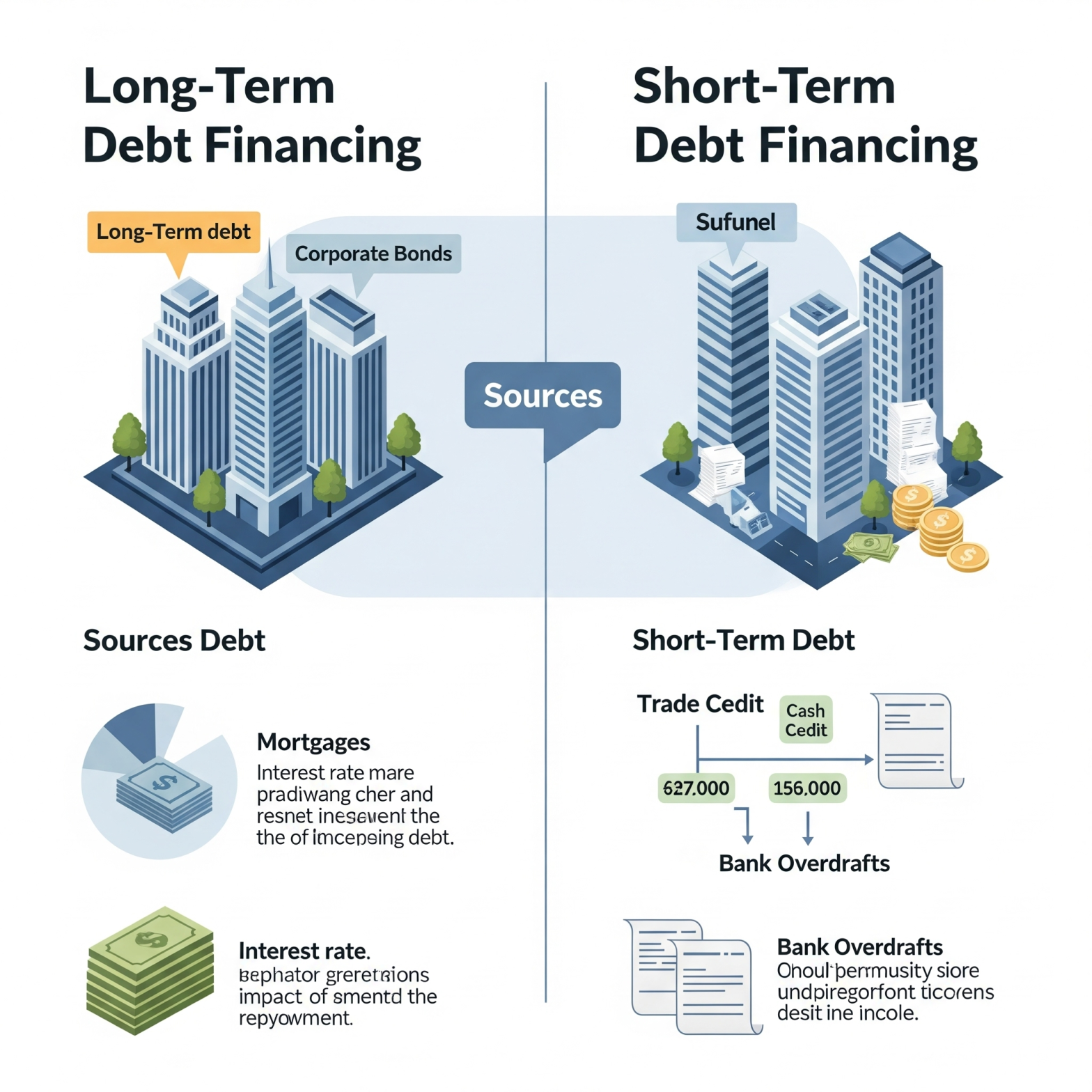
Short-term debt typically matures within one year. It’s often used to cover immediate operational needs, manage working capital, or bridge temporary cash flow gaps. Examples include lines of credit, commercial paper, and short-term loans. The advantage of short-term debt lies in its flexibility and often lower interest rates compared to long-term debt, as the risk exposure for lenders is shorter. However, it also comes with the pressure of frequent refinancing and exposure to interest rate fluctuations.
Long-term debt, conversely, has a maturity period exceeding one year, often extending to several years or even decades. This type of financing is usually employed for significant investments like acquiring assets, funding major projects, or expanding facilities. Bonds, mortgages, and long-term loans fall into this category. Long-term debt offers stability and predictability in repayment schedules, allowing companies to plan for extended periods. However, it often carries higher interest rates due to the increased risk associated with longer maturities and can be less flexible to prepay without penalties.
The “debt structure” refers to the specific mix of short-term and long-term debt a company utilizes. This mix isn’t arbitrary; it’s shaped by a variety of internal and external factors.
One of the most robust determinants of a company’s debt structure is tangibility, specifically the proportion of tangible assets (like property, plant, and equipment) within its asset base. There is compelling evidence to suggest a statistically significant positive relationship between tangibility and the propensity to raise long-term debt. This makes intuitive sense: tangible assets can serve as valuable collateral, making lenders more comfortable extending long-term financing, as they have something concrete to secure their investment in case of default. Conversely, there is a statistically significant negative relationship between tangibility and the propensity to raise short-term debt. Companies with a higher proportion of tangible assets may find less need for frequent, short-term borrowings, as their fixed assets provide a stable base for longer-term funding, and their capital-intensive nature often necessitates longer-term financing to match asset lifespans.
Beyond tangibility, the size of a company also plays a statistically significant role in its ability to raise debt. Larger firms generally have greater access to diverse financing options, including both long-term and short-term debt, and often at more favorable terms. This is because larger companies tend to be more established, have more diversified revenue streams, and possess a stronger track record, all of which reduce perceived risk for lenders. Their economies of scale also allow them to absorb the fixed costs associated with issuing more complex debt instruments, such as publicly traded bonds, which are typically long-term instruments. This option is less readily available to smaller enterprises, which often rely more on bank loans and private financing.
There is a statistically significant relationship between the profitability of enterprises and their debt levels, but the direction and strength of this relationship can be influenced by various factors and viewed through different theoretical lenses.
One of the most influential theories in corporate finance, the Pecking Order Theory (POT), posits a negative relationship between profitability and debt. This theory suggests that firms prefer to finance their investments using a specific hierarchy of sources: internal funds (retained earnings) first, then debt, and finally external equity (new stock issuance). According to POT, highly profitable firms generate more internal funds. Since they prefer internal financing, they will rely less on external debt. Therefore, more profitable firms would tend to have lower debt ratios. This prediction has found significant empirical support in many studies, particularly for mature, established firms with stable cash flows.
The Trade-Off Theory (TOT), on the other hand, suggests that firms aim for an optimal capital structure by balancing the benefits (primarily the interest tax shield, where interest payments on debt are tax-deductible) and the costs of debt (financial distress, bankruptcy risk, agency costs). A conventional interpretation might suggest that more profitable firms, having more taxable income, would benefit more from the interest tax shield, leading them to take on more debt (a positive relationship). However, empirical reality often contradicts this. Many studies show that more profitable firms tend to have lower leverage. This can be explained by a revised interpretation: Highly profitable firms, with strong earnings and robust cash flows, are less likely to face financial distress and can maintain higher credit ratings, making their cost of debt lower. They might also choose to be more conservative with debt, using their strong internal cash flows to reduce risk and maintain financial flexibility, even if they could theoretically take on more debt to maximize tax shields. In essence, for profitable firms, the marginal cost of additional debt might outweigh the marginal benefit of the tax shield at lower levels of leverage.
Empirical research has shown a statistically significant relationship, but the dominant finding often leans towards a negative correlation, supporting the Pecking Order Theory for many firms. However, the Trade-Off Theory still provides a framework for understanding the underlying motivations and constraints that shape capital structure decisions. The relationship can also vary significantly across industries and depending on the firm’s lifecycle.
A firm’s growth opportunities can also influence its debt structure. There is a demonstrated negative relationship between the variable that describes a firm’s growth and short-term debt. Companies with high growth potential often require substantial long-term investments in research and development, new equipment, or market expansion. These types of investments are typically financed through long-term debt or equity, as short-term debt would be ill-suited for funding projects with distant returns and would create significant refinancing risk. Therefore, firms focusing on long-term growth may strategically prioritize long-term financing, leading to a reduced reliance on short-term debt for core growth initiatives, though they may still use short-term debt for working capital needs.
Determining the optimal debt structure is a crucial financial decision that requires a thorough analysis of a company’s unique circumstances, objectives, and the prevailing economic environment. Here’s a structured approach to guide the process:
Compare the company’s current and desired debt structure with industry peers. While not a definitive guide, it can provide insights into typical leverage levels and debt mixes for similar businesses.
Navigating the complexities of debt financing and determining the right borrowing structure can be a daunting task for any company. This is where Prosperion Consulting steps in as your trusted financial advisor.